Recent concerns over fire hazards in healthcare facilities have prompted the Joint Commission – responsible for the accreditation of more than 20,000 healthcare facilities nationwide – to take a closer look at fire hazard regulation compliance in healthcare facilities across the country. Much of the concern is over waste disposal and bins.
The Joint Commission cites the National Fire Protection Association as the source of its rules concerning these subjects. But these rules can be a bit difficult to parse through. This presents a challenge, as compliance with these rules is paramount in regards to both safety standards and the prevention of fire and fire hazards in the healthcare facility. This guide will help explain the finer details laid out by the rules endorsed by the Joint Commission.
Different Rules for Different Bins
First, there are two different forms of waste bins addressed by the Joint Commission’s requirements. The two separate areas of concern are that of non-hazardous trash (bottles, cans, paper waste featuring non-sensitive information) and patient records set to be destroyed (also non-hazardous, but requiring a different protocol for their disposal), and that of hazardous waste, like soiled linens, papers or other items that represent biohazards or are otherwise unsafe for human contact. The details surrounding the different protocols for each are outlined in the meeting minutes for an NFPA meeting held in July of 2019. The language of these rules is consistent with current Joint Commission requirements.
NFPA 101 rules offer specific stipulations regarding soiled linen and trash receptacles to prevent creation of a fire hazard. The rules for these materials are more stringent, as certain contaminants can serve as fire accelerants. First, the rules require receptacles for these types of trash to be no larger than thirty-two gallons in volume. Additionally, the average density of these containers’ capacity in a room may not exceed one half galloon per square foot. This means the largest rule-compliant receptacles must be placed in a room no smaller than sixty-four square feet. Receptacles that are larger than this must be located in a room designated and protected as a hazardous area. Within these hazardous areas, there are no limits on container size or density – but only within these specific areas.
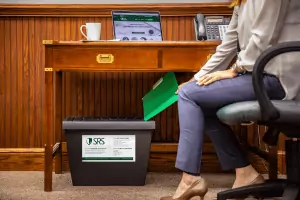 Containers for clean waste or records set to be destroyed are exempted from these rules, so long as they are smaller than ninety-six gallons in capacity. Containers for clean waste or records set to be destroyed that exceed that size must be located in a room protected as a hazardous area when not attended. Keep in mind to maximize cost-efficiency for the client, shredding containers come in several sizes, including compact under desk containers, 32-gallon executive consoles, 64-gallon rolling bins, and 96-gallon rolling bins. If a facility chooses to keep both their shred bin and another receptacle for non-hazardous/non-confidential waste in the same room, this could be a violation of the Joint Commission standards if the total volume of the two bins exceeds ninety-six gallons. As your organization evaluates needs in terms of both cost and compliance, one of our helpful team members would be happy to walk you through these considerations.
Complex Rules, Simplified
In essence, the rules are simple: Hazardous waste must be stored in no greater than thirty-two-gallon containers in large rooms, and non-hazardous waste must be stored in no greater than ninety-six-gallon containers. Any larger, and you’ll need a designated hazardous area for storage.
As always, at Secure Records Solutions, we have our clients’ best interests in mind. In addition, we’re here to serve your data destruction needs: Healthcare facilities with high volumes of records waiting to be destroyed may remain in compliance with Joint Commission rules and save waste disposal space with a few careful considerations regarding placement. If you’re interested or have further questions regarding the Joint Commission rules outlined here, contact Secure Records Solutions today.